
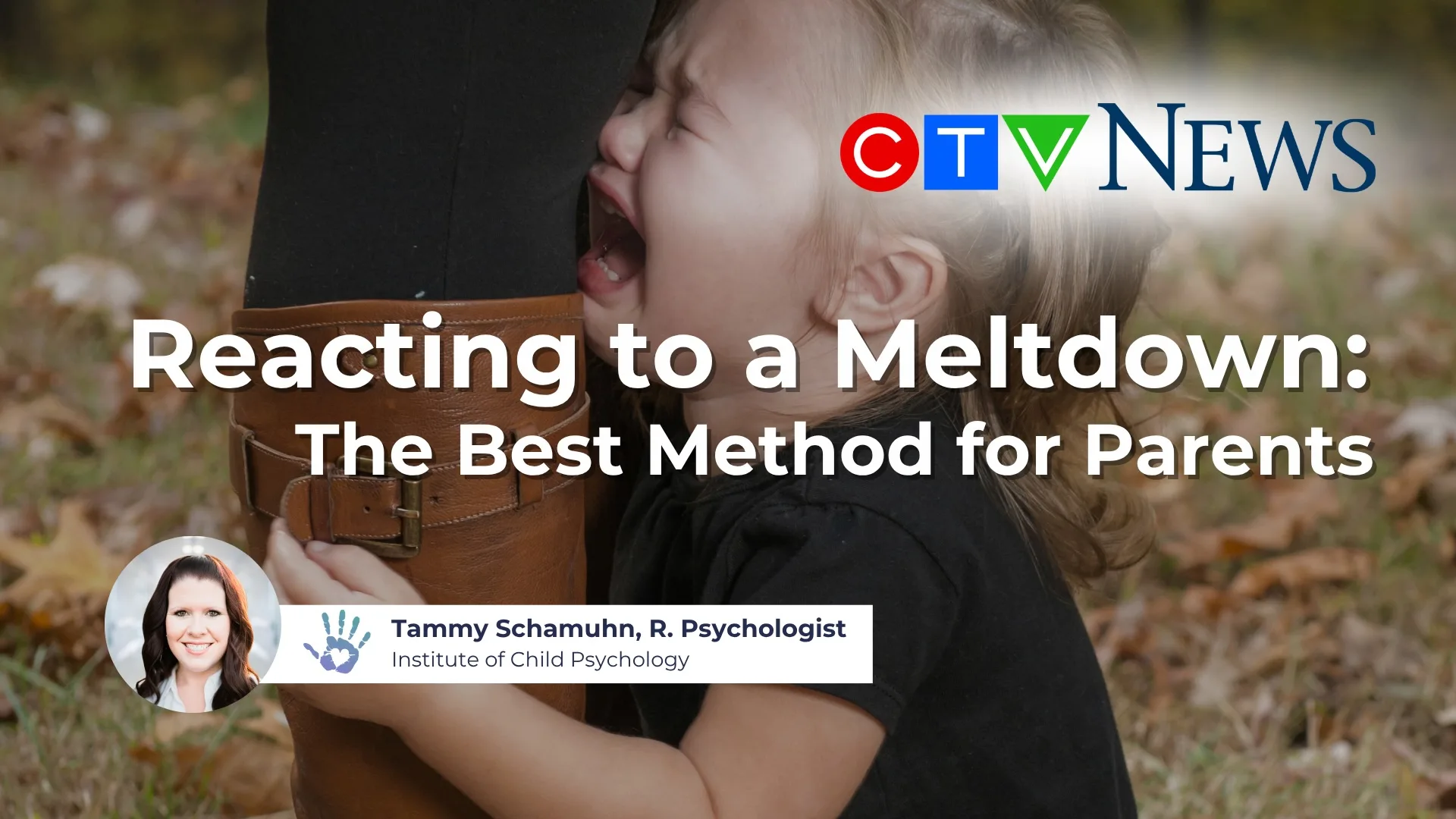
What to Do When Your Child Is Having a Meltdown:
Tammy Schamuhn on CTV News
When a child is in the middle of a meltdown, it can be difficult for parents to know what to do. Do you comfort them? Set a boundary? Give them space? Try to reason with them?
Tammy Schamuhn, Registered Psychologist and Co-Founder of the Institute of Child Psychology, recently joined CTV News Edmonton to discuss how parents can respond to children’s meltdowns—and why understanding what is happening beneath the behaviour can make all the difference.
A Meltdown Is More Than “Bad Behaviour”
When children become overwhelmed, the parts of the brain responsible for reasoning, problem-solving, and impulse control can become much harder to access.
That means the middle of a meltdown usually isn’t the best time for lectures, consequences, or lengthy explanations. A child who is highly dysregulated first needs help returning to a calmer state.
Instead of asking, “How do I stop this behaviour?” it can be helpful for parents to consider:
“What does my child need from me right now to feel safe enough to regulate?”
Regulate First, Teach Later
One of the most important principles for navigating big emotions is simple: regulation comes before reasoning.
Children develop emotional regulation through repeated experiences of co-regulation—having a calm, safe adult help them move through overwhelming emotions.
In the moment, this may mean lowering your voice, using fewer words, slowing down your own body, staying nearby, or offering comfort when your child is receptive to it.
Once your child’s nervous system has settled, you can return to the behaviour, reinforce boundaries, problem-solve, and talk about what they might do differently next time.
Parents Don’t Have to “Fix” Every Feeling
Anger, frustration, disappointment, and sadness are normal parts of childhood. Our job isn’t necessarily to make uncomfortable feelings disappear.
Instead, we can help children learn an incredibly important lesson:
Big feelings are manageable. You can move through them. And you don’t have to do it alone.
Over time, these everyday moments become opportunities for children to develop emotional awareness, coping skills, resilience, and the ability to regulate themselves more independently.
Watch Tammy Schamuhn on CTV News
Watch the full CTV News Edmonton segment, “The Best Methods for Reacting to a Meltdown,” to hear Tammy share practical guidance for parents navigating tantrums, meltdowns, and big emotions.
For more evidence-based resources on child development, emotional regulation, parenting, anxiety, behaviour, and children’s mental health, explore the Institute of Child Psychology’s courses, workshops, podcast, and parenting resources.





Comments are closed.