
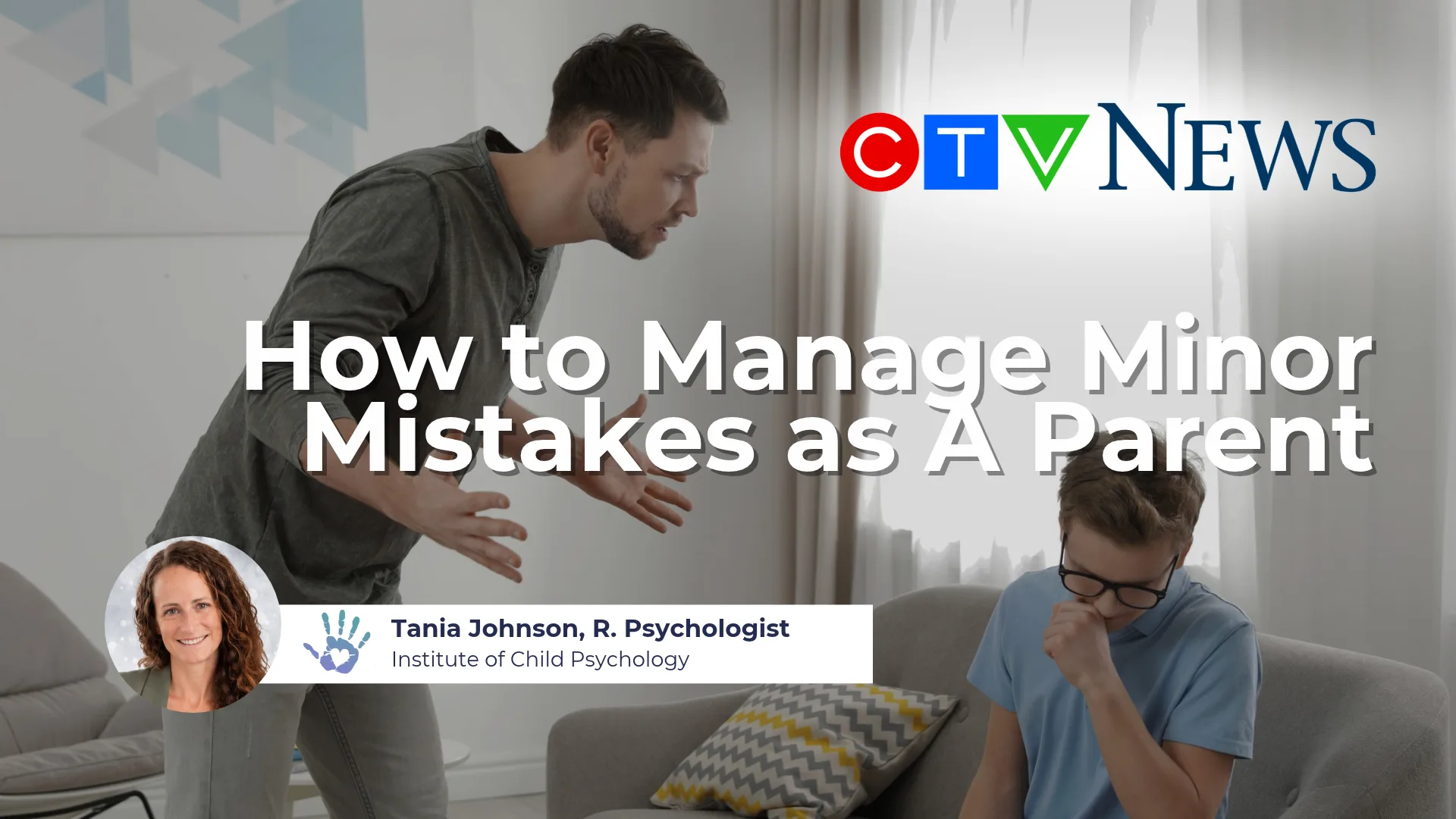
Why Does My Child Fall Apart Over Small Mistakes?
Tania Johnson, Registered Psychologist and Co-Founder of the Institute of Child Psychology, recently joined CTV Edmonton to talk about why seemingly minor mistakes can trigger such big reactions in children — and what parents can do to help.
The milk spills.
They get one question wrong on their homework.
Their drawing doesn’t look the way they wanted.
They lose a game they were sure they were going to win.
And suddenly, your child is in tears, crumpling the paper, yelling, storming away, or declaring:
“I CAN’T DO IT!”
To an adult, the size of the reaction can seem completely out of proportion to what happened.
But often, the mistake isn’t really the problem.
When a Small Mistake Feels Huge
Children are still developing the ability to tolerate frustration, manage disappointment, regulate strong emotions, and recover when things don’t go according to plan.
That means something that feels relatively insignificant to us can feel enormous to them.
A child who becomes overwhelmed by a small mistake may not simply be “overreacting.” Their nervous system may already be carrying more than we can see.
Maybe they’re tired.
Maybe school took everything out of them.
Maybe they’ve been trying hard to hold themselves together all day.
Maybe they’re anxious, highly sensitive, perfectionistic, hungry, overstimulated, or simply running low on their ability to cope.
Then the pencil breaks.
And everything falls apart.
The broken pencil may be the trigger, but it isn’t necessarily the whole story.
Why “It’s Not a Big Deal” Usually Doesn’t Help
When we know something is fixable, our instinct is often to reassure:
“It’s okay!”
“It was just a mistake.”
“You can try again.”
“This isn’t a big deal.”
The problem is that when a child is emotionally flooded, logic often isn’t what they need first.
In fact, telling a distressed child that something “isn’t a big deal” can accidentally communicate something very different:
You shouldn’t be feeling this way.
Instead of trying to convince them that the problem is small, we can help their nervous system experience something important:
Big feelings are survivable.
Regulate First. Teach Later.
When emotions are high, keep your response simple.
You might say:
“Oh, that was really frustrating.”
“You wanted that to work.”
“I’m right here.”
And then — sometimes — say less.
Your calm presence can do more than a lengthy explanation.
Once your child has settled, then you can help them think about what happened:
“That didn’t go the way you hoped. What could we try next?”
This is where resilience develops.
Not by preventing frustration.
Not by immediately fixing every problem.
And not by demanding that children “calm down.”
Children build resilience through repeated experiences of encountering something difficult, being supported through the discomfort, and discovering:
I can handle this.
Be Careful About Rescuing Too Quickly
Watching our children struggle can be uncomfortable for us, too.
So we fix the Lego tower.
Replace the drawing paper.
Email the teacher.
Let them win the game.
Solve the problem.
Sometimes children absolutely need our help. But if we continually remove ordinary frustration, children lose opportunities to develop one of childhood’s most important capacities: frustration tolerance.
Our job isn’t to create a childhood without mistakes.
It’s to help children learn that mistakes are something they can move through.
Help Your Child Build a Different Relationship With Mistakes
Children watch how we respond to our own mistakes, too.
If we spill something and mutter, “I’m such an idiot,” they notice.
If we become intensely frustrated when something doesn’t work immediately, they notice that too.
But they also notice when we say:
“Oops. I made a mistake. I’ll clean it up.”
Or:
“That didn’t work. I’m going to try another way.”
That kind of modelling quietly teaches children that mistakes aren’t emergencies.
They’re part of learning.
The Goal Isn’t a Child Who Never Gets Upset
We don’t need children to respond perfectly every time something goes wrong.
And we don’t need to eliminate big feelings.
The deeper goal is to help children gradually develop the capacity to feel disappointment without being consumed by it, tolerate frustration without immediately escaping it, and make mistakes without believing the mistake says something about who they are.
That takes time.
So the next time your child falls apart because the toast broke, the drawing didn’t work, or they got the answer wrong, look beyond the size of the problem.
Ask yourself:
What is happening underneath this reaction — and what does my child need from me right now?
Sometimes the most powerful thing we can offer isn’t a solution.
It’s a calm adult who communicates:
This is hard. And I know you can get through hard things.
Watch Tania on CTV Edmonton
Tania Johnson, Registered Psychologist, Registered Play Therapist, and Co-Founder of the Institute of Child Psychology, recently joined CTV Edmonton to discuss how parents can help children navigate minor mistakes, frustration, and those surprisingly big emotional reactions.
Watch the CTV Edmonton segment: “How to manage minor mistakes as a parent.” CLICK HERE.






Comments are closed.